What Is an RFI (Request for Information) in Construction?
A Request for Information (RFI) is a formal written question raised on a construction project when drawings, specifications or other contract documents are unclear, incomplete or in conflict. It asks the designer or employer for a clarification, and the question and answer are recorded as a project document.
What does RFI mean in construction?
On site, an RFI is how the contractor asks the design team for an answer in writing. A typical RFI points out a conflict between two drawings, a missing dimension, a specification that cannot be met with the product shown, or a site condition that was not anticipated. The answer is written down so everyone builds from the same instruction.
An RFI is a clarification, not an instruction to change the scope. If the answer changes the work, it may lead to a variation, which is handled separately.
Purpose of an RFI
A good RFI process does three things:
- It gives site teams a written answer instead of a verbal one, so decisions can be traced later.
- It sets a response date, which matters when late answers hold up work.
- It builds a log of questions and answers that is useful for claims, handover and lessons learned.
How to write an RFI
Keep each RFI to one question and make it easy to answer:
- Give a number, date, project, the person it is addressed to and the response date you need.
- State the question in one or two sentences and quote the document, drawing number, revision and detail it refers to.
- Attach a sketch, photograph or marked-up drawing that shows the problem.
- If you have a proposed solution, state it, and say what is affected if the answer is late (activity, cost, date).
- Record the reply, who gave it and the date, then close the RFI.
RFI example
Example wording: 'Drawing A-210 rev C shows a 150 mm partition at gridline D, while structural drawing S-105 rev B shows a 250 mm beam at the same location. Please confirm which governs and the head height of the partition. Response required by the date shown, as blockwork is scheduled to start soon after.' The details are illustrative.
RFIs on Gulf projects
Most Gulf contracts require questions to be raised through a defined channel, often the consultant or engineer, and many project procedures set a response period for RFIs. The period and the route are set by the contract and project procedures, so follow those rather than a generic standard.
FIDIC conditions do not define an RFI form, but the contract's notice and communication clauses and the engineer's instruction clauses govern what happens when an answer changes the works.
How Arkan handles RFIs
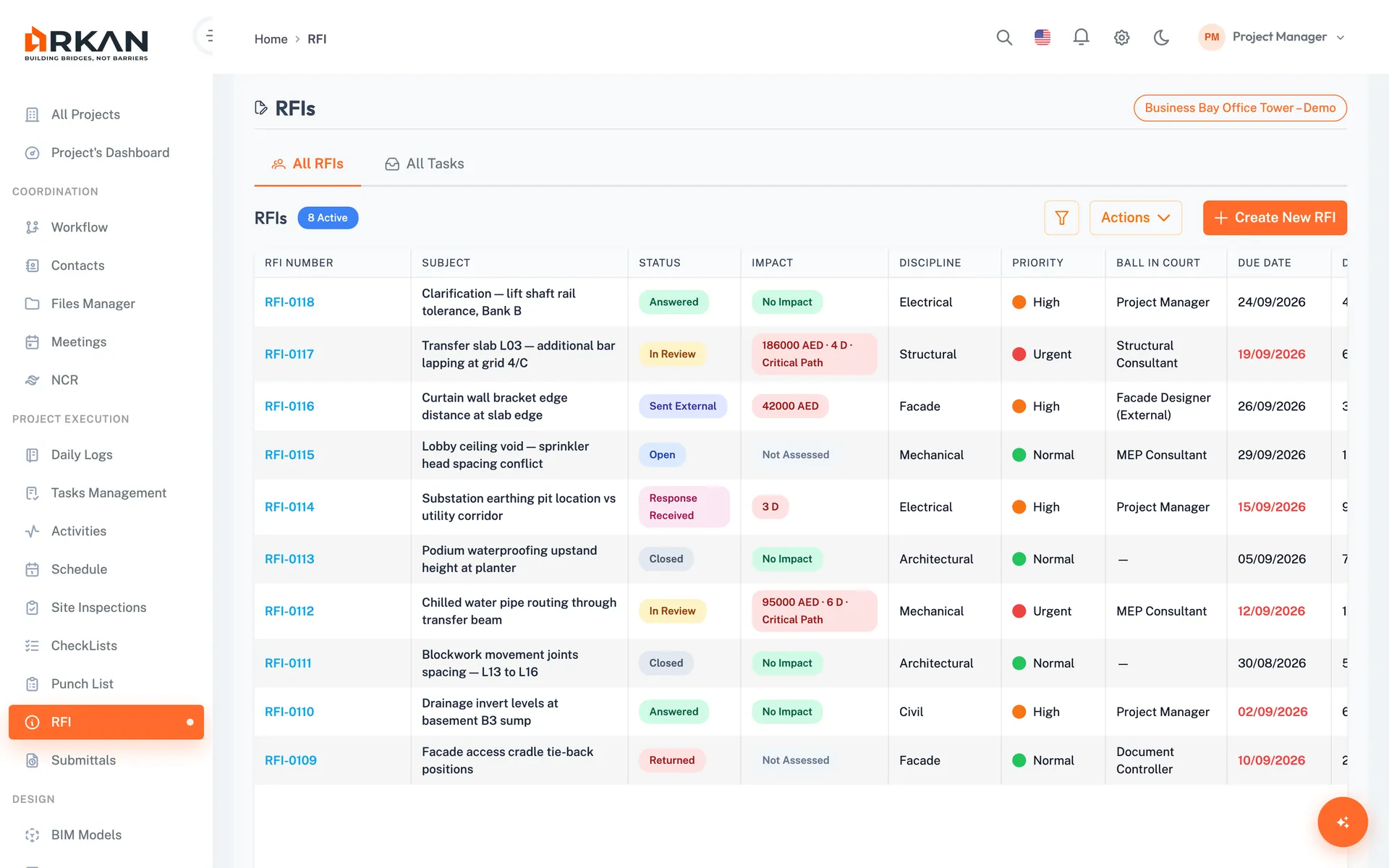
Arkan's RFI module replaces the email-and-spreadsheet log with a record that keeps each question, response and status together.
- Create an RFI as a draft, then send it through a configurable workflow or out to external contacts.
- Add internal or external responses and mark one as the official response.
- Track status (Draft, Open, In Review, Answered, Closed and others) and priority (Normal, High, Urgent).
- Export the RFI list to Excel. RFIs can also be raised from the BIM viewer, linked to the model element.
Frequently asked questions
What is the RFI full form in construction?
RFI stands for Request for Information. Some teams call it a request for clarification or technical query (TQ), but the idea is the same: a formal written question with a written answer.
What is the difference between an RFI and a submittal?
An RFI asks a question about the design or documents. A submittal sends something for approval, such as a material sample, shop drawing or product datasheet. An RFI is answered; a submittal is reviewed and given a status.
Who answers an RFI?
The party responsible for the document in question: usually the architect, engineer or consultant, sometimes through the project manager. The route should be written in the project procedures.
How long should an RFI take to answer?
There is no universal number. Contracts and project procedures set the period, and the RFI should state the date by which an answer is needed. Delays in answering can support a request for extension of time, depending on the contract.
Related terms
Related calculators
Read next
Last updated: 2026-10-13. Definitions are general guidance. Your contract and project procedures govern.