What Are Liquidated Damages (LDs) in Construction?
Liquidated damages (LDs) are a pre-agreed amount, usually a daily or weekly rate, that a contractor must pay the employer if the works are not completed by the contractual date. They are fixed in the contract in advance as a genuine estimate of the employer's loss from delay, avoiding the need to prove it later.
What are liquidated damages in a construction contract?
The contract states a rate, for example per day of delay, and often a maximum cap as a percentage of the contract price. If the contractor completes after the completion date as adjusted by any extensions of time, the employer can deduct or claim the damages for the period of delay, up to the cap. They are in place of proving actual loss, not in addition to it.
FIDIC conditions call them 'delay damages' in the current editions; older editions and many bespoke contracts use the name 'liquidated damages'.
Purpose of liquidated damages
LDs serve both parties:
- The employer has a clear remedy for late completion without a lengthy proof of loss.
- The contractor knows its maximum exposure when pricing the job.
- Both parties have an incentive to manage the programme, and to agree extensions of time when delays are not the contractor's fault.
How liquidated damages are calculated
The calculation is simple once the dates are agreed: days of delay multiplied by the daily rate, limited by any cap. The hard part is establishing the days of delay, which depends on the approved completion date after extensions of time.
Worked example (illustrative): completion date 30 June as extended; actual completion 20 July = 20 days late. At a rate of 5,000 per day, damages = 100,000. If the cap is 100,000, the cap applies and further delay adds nothing.
How to reduce exposure to liquidated damages
Contractors can protect themselves by working in a disciplined way:
- Keep an up-to-date programme and record delay events as they happen, with the notices the contract requires.
- Submit extension of time claims with supporting programme analysis within the contractual time.
- Keep daily records, correspondence and instructions that show causes of delay.
Liquidated damages on Gulf projects
Delay damages are common in Gulf construction contracts and are typically stated as a daily rate with a cap. In FIDIC 1999 the clause is 8.7 (Delay Damages) and in the 2017 edition 8.8. Extension of time sits next to it (8.4 in 1999, 8.5 in 2017). Check the particular conditions, which often change these provisions.
Under UAE law, a court can in some circumstances adjust agreed damages that are exaggerated or where no loss occurred, and other Gulf countries have their own rules. Take legal advice before relying on or resisting a deduction.
How Arkan supports delay management
Arkan does not calculate or deduct liquidated damages. What it helps with is keeping the schedule evidence that delay discussions depend on.
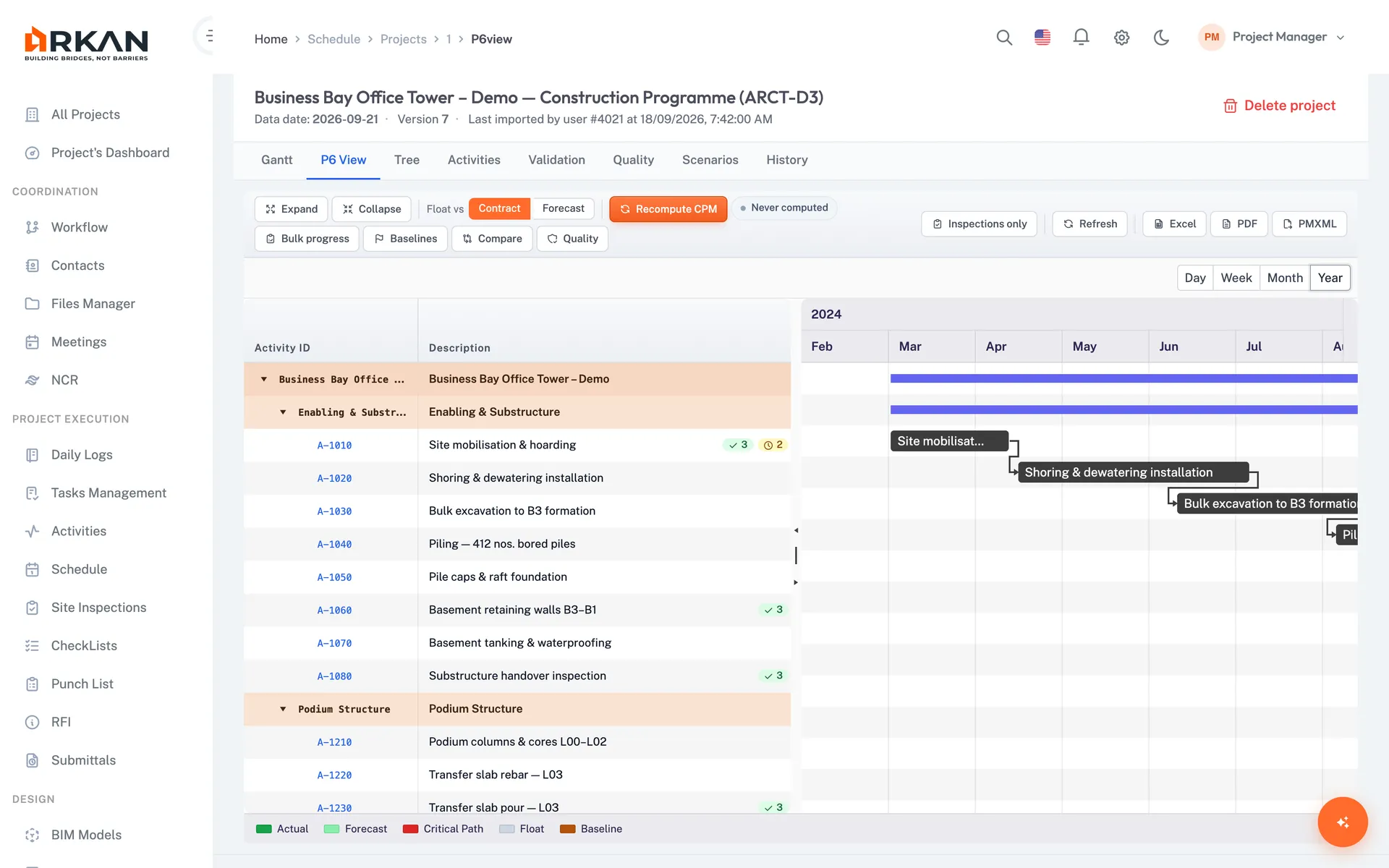
- Upload Primavera P6 files (.xml or .xer) and view activities in Grid and Gantt, with a critical path analysis and an expected project end date.
- Compare two schedule versions to see what moved between them.
- Keep daily logs, RFIs and documents in the same project so the supporting record is in one place.
- For the arithmetic, use our free liquidated damages calculator.
Frequently asked questions
What is the difference between liquidated damages and a penalty?
Liquidated damages are a genuine pre-estimate of the employer's loss from delay. A penalty is designed to punish. Whether a clause is enforceable as written depends on the law of the contract, which differs between countries.
How are liquidated damages calculated?
Multiply the days of delay beyond the adjusted completion date by the daily rate stated in the contract, up to any cap. Our free calculator can do the arithmetic once you have the dates and rate.
Do extensions of time affect liquidated damages?
Yes. An extension of time moves the completion date, so fewer days of delay count. That is why timely, well-supported extension of time claims matter.
Can the employer claim both liquidated damages and actual losses?
Generally the liquidated sum replaces proof of actual loss for the delay, subject to the contract's wording. Check the clause and take legal advice for any dispute.
Related terms
Related calculators
Read next
Last updated: 2026-10-13. Definitions are general guidance. Your contract and project procedures govern.