What Is an Inspection and Test Plan (ITP) in Construction?
An Inspection and Test Plan (ITP) is a quality document that lists, for one type of work, each inspection and test to be carried out, the standard or specification it is checked against, who performs it and who must witness or approve it before work continues.
What is an ITP in construction?
An ITP turns the specification into a sequence of checks. For a work activity such as concrete placement, it lists the steps in order: material approval, formwork and reinforcement inspection, pre-pour check, concrete testing, curing and final acceptance. Each step names the reference document, the acceptance criteria and who signs it off.
The contractor normally prepares the ITP and submits it to the consultant for approval before the work starts.
Hold points, witness points and surveillance
Many ITPs mark each step with how much control the client or consultant keeps:
- Hold point: work must stop until the inspector has inspected and released the step.
- Witness point: the inspector is invited to attend; if they do not attend after notice, work may proceed as the plan allows.
- Review or surveillance: the contractor inspects and the records are reviewed afterwards.
How to prepare an ITP
A workable ITP is short and specific to one activity:
- List the activity's steps in the order they happen on site.
- For each step, name the specification clause or standard, the acceptance criteria and the record that proves it (test report, checklist, survey).
- Assign who inspects (contractor, consultant, third party) and mark hold, witness or review points.
- Submit the ITP for approval, then issue the approved revision to site and keep every completed record with it.
ITP example
A masonry ITP might include: approve block samples; check setting-out; inspect first course and damp-proof course (hold point); check reinforcement and grouting; inspect finished wall for line, level and plumb. Each row would carry the specification reference, acceptance criteria and sign-off column. Our free ITP template gives you this layout, blank.
ITPs on Gulf projects
On most Gulf projects the consultant or the client's supervision team approves the contractor's ITPs before the activity starts, and inspection requests are raised against them (often called a Request for Inspection, RFI or IR depending on the project). Third-party testing laboratories commonly provide the test results referenced in an ITP.
Hold and witness point conventions and who may inspect are set by the project quality plan and specification.
How Arkan handles ITP inspections
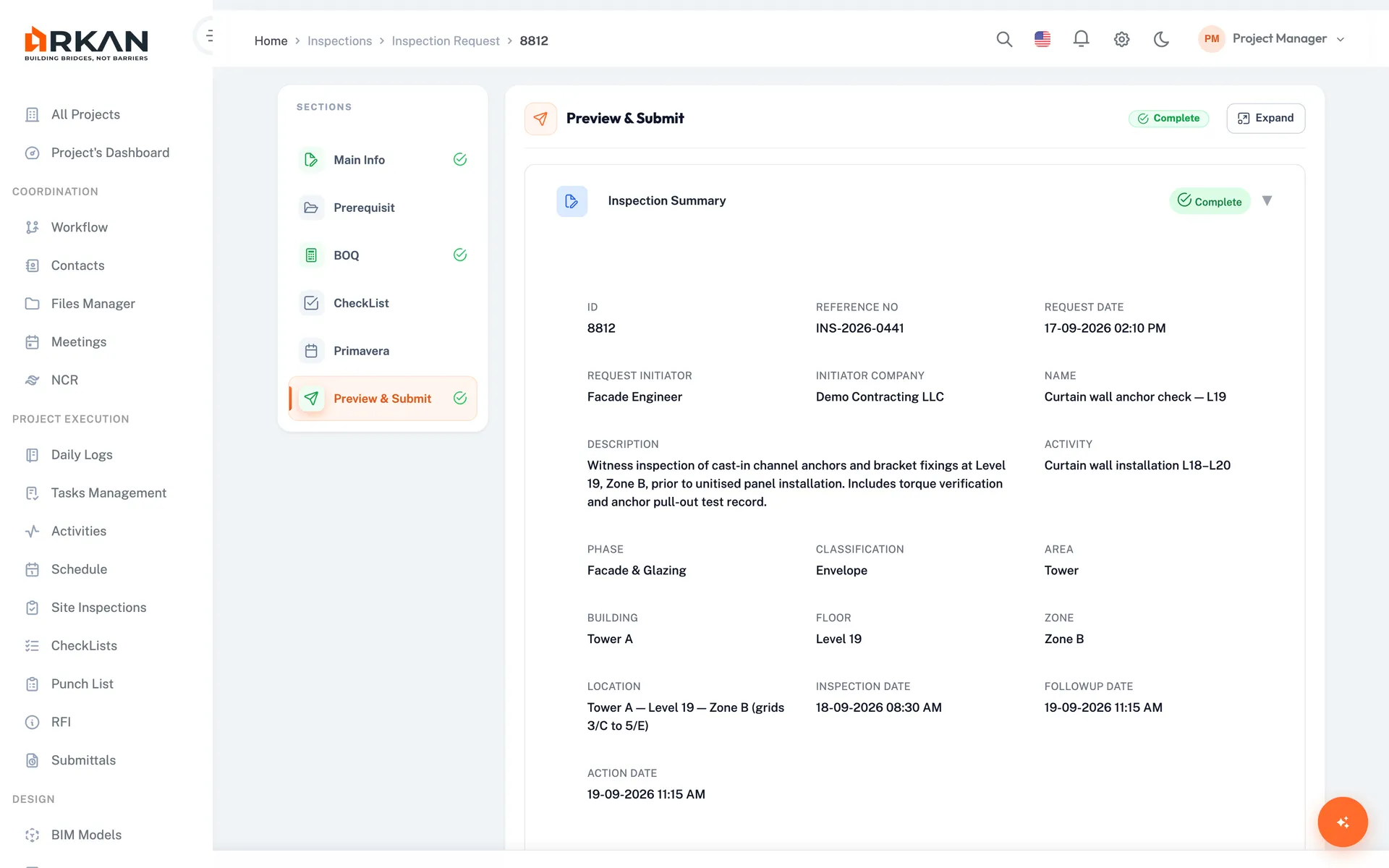
Arkan does not write your ITP for you. Keep the approved ITP in document control, and use Arkan to raise and track the inspections the plan calls for.
- Inspection requests follow a 6-step flow: main information, prerequisites, BOQ, checklist, Primavera schedule and preview before submission.
- Checklists are built from a question bank with five question types, and can be attached to inspections.
- Track request status on the inspection dashboard and export inspection reports to PDF.
- Inspections can be linked to BOQ items, which feeds progress into payment requests.
Frequently asked questions
What is the ITP full form in construction?
ITP stands for Inspection and Test Plan. Some projects call the same thing a Quality Control Plan or an Inspection and Test Procedure, although those can have a slightly different scope.
What is the difference between an ITP and a checklist?
An ITP is the approved plan for a type of work, listing all inspection and test steps and who controls them. A checklist is the form used on site to record the result of an individual inspection against that plan.
What is a hold point in an ITP?
A hold point is a step where work must not proceed until the named inspector has inspected the work and signed the release. It is used where covering up or continuing would make the work hard or impossible to check later.
Who approves the ITP?
Normally the consultant or client representative approves the contractor's ITP, according to the contract and the project quality plan. Third parties may also review it where the specification requires.
Related terms
Read next
Last updated: 2026-10-13. Definitions are general guidance. Your contract and project procedures govern.